Unified English Braille · US Letter PDF
Free braille printables
Three braille sheets to print at home or at school: the braille alphabet chart, flashcards a to z to cut out, and a one-page chart of the most used contractions in Unified English Braille (UEB), the code of the US, the UK, Canada and Australia. No sign-up, free to photocopy.
Printed braille is for the eyes, not for touch. A home printer puts the dots on paper as flat ink: sighted learners, teachers and families can read them, but no one can feel them. To make braille that can be read with the fingers, see how to make it tactile.
The printables
-
Braille alphabet chart
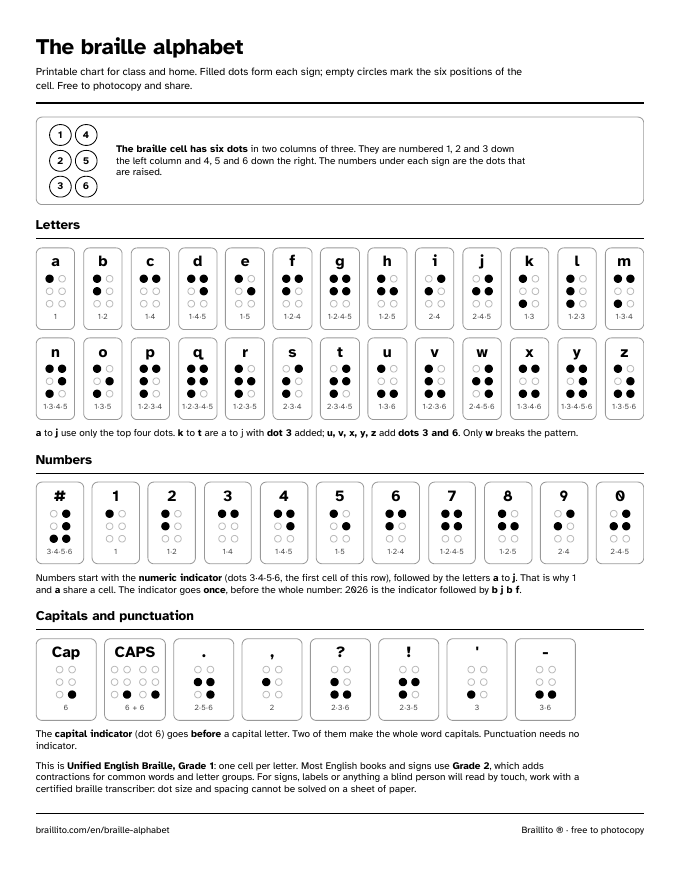
A reference for the wall, the fridge or a binder: anyone learning braille by sight can look up a letter, a number or a capital in a second.
To print: Print it at actual size. Black and white is enough.
Download the PDF (1 page, 80 KB) -
Braille alphabet flashcards A–Z
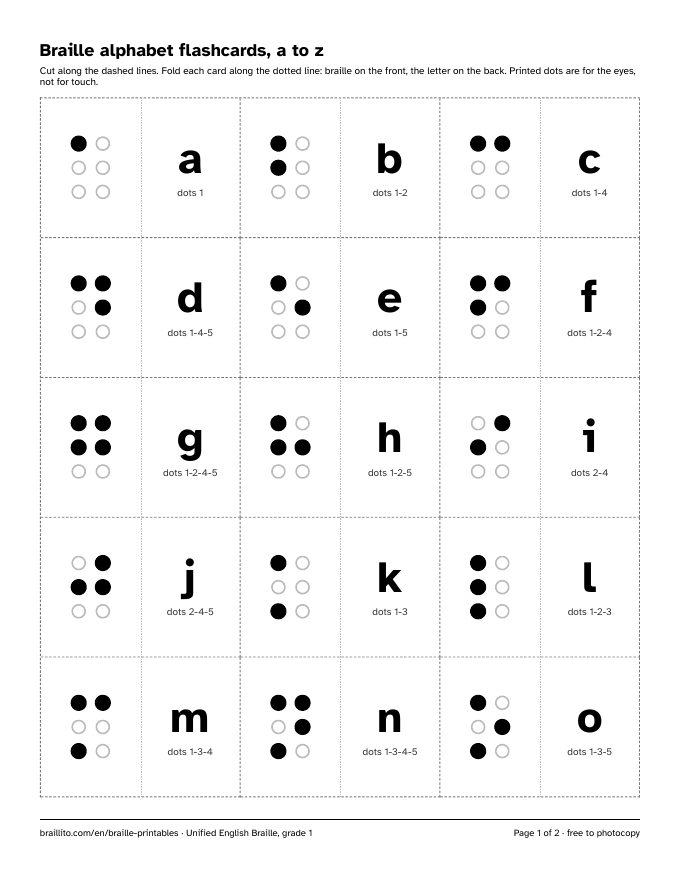
Practice by sight: show the braille half and name the letter, sort the cards into the rows a–j, k–t and u–z (only w breaks the pattern), or lay them out to spell a name.
To print: Print at actual size, on cardstock if your printer takes it. Cut along the dashed lines, then fold each card along the dotted line so the letter is on the back.
Download the PDF (2 pages, 96 KB) -
Unified English Braille (UEB) chart
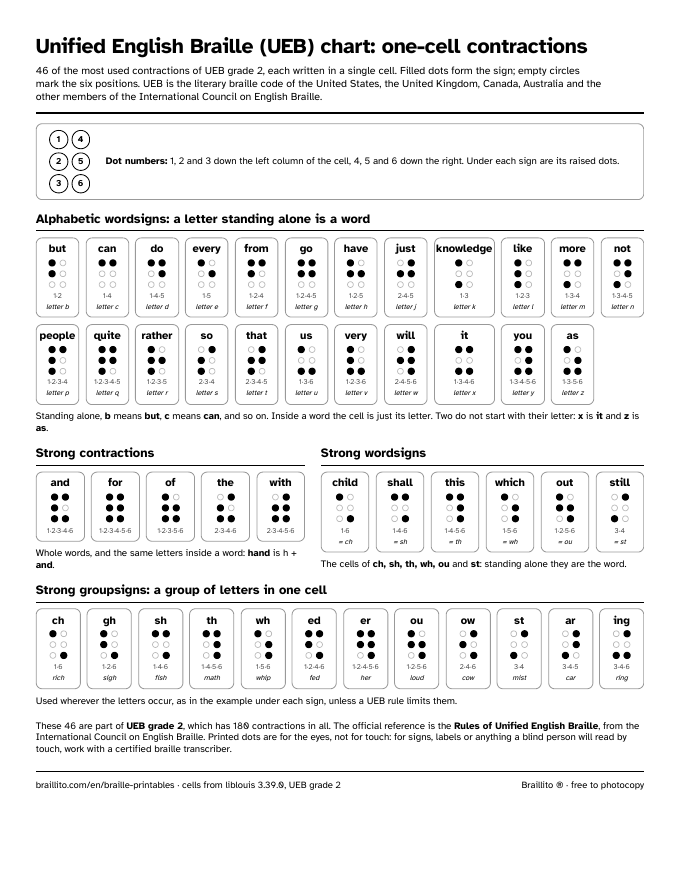
For the step from grade 1 to grade 2: the single-cell signs that show up in almost every line of English braille, on one sheet next to the book or the screen.
To print: Print it at actual size. Black and white is enough.
Download the PDF (1 page, 88 KB)
How to print them
- Open the PDF and choose Print.
- On US Letter paper, set the scale to Actual size or 100%, not Fit.
- On A4 paper, choose Fit or Shrink oversized pages. The Letter page is 216 mm wide and A4 is 210 mm, so it prints at about 97% and nothing is cut off.
- Black and white is enough. For the flashcards, cardstock lasts longer than plain paper.
The cells on these sheets are drawn bigger than real braille, so they can be seen across a table. They show which dots make each sign; they are not a template for the size of real braille.
How to make them tactile
With a braille embosser. Type the text into our English braille translator, choose grade 1 or grade 2 and press Download .brf. The .brf file holds the braille in Braille ASCII, the format embossers read, so a school, a library or an agency with an embosser can print it in raised dots.
By hand, with a slate and stylus. You press each dot into heavy paper, right to left and in mirror image, so it can be read on the other side. Our guide to the braille slate and stylus shows how, letter by letter. For labels on jars, clothes or medicine, see braille labels.
For signs, menus or anything a blind person will rely on, work with a certified braille transcriber. More free material, from courses to rulebooks, is in our list of free braille resources.
Once you know the letters, an iPhone can take you further with no paper at all: VoiceOver lets you type braille on the screen and read it on a braille display. Our guide to braille on iPhone shows how.
Frequently asked questions
Can you print braille on a regular printer?
Not braille you can feel. A regular printer puts the dots on paper as flat ink, so the sheet is a picture of braille that sighted learners, teachers and families can read. Raised braille needs a braille embosser, a slate and stylus, or a braillewriter.
Are these braille printables free?
Yes. The three PDFs are free to download, print and photocopy for class or home, with no sign-up.
Do the PDFs print on A4 paper?
Yes. They are US Letter. On A4, choose Fit or Shrink oversized pages in the print dialog: the page prints at about 97% and nothing is cut off.
Which braille code do they use?
Unified English Braille (UEB). The alphabet chart and the flashcards are grade 1, one cell per letter, and the 26 letters are the same as in the older EBAE code. The contractions chart is UEB grade 2.
From the sheet to the screen
Practice the braille cells every day with Braillito
Braillito teaches braille from scratch, with 59 lessons in 8 worlds, in 38 languages, English included: exercises you play, with lives, levels and a daily streak. It does not teach the grade 2 contractions.
It is a subscription with no free version: depending on the plan, it starts with a free trial or a discounted first period, only if it is your first subscription.
Works with VoiceOver and TalkBack