
Unified English Braille · Free chart
The braille alphabet: letters A to Z, numbers and punctuation
Updated
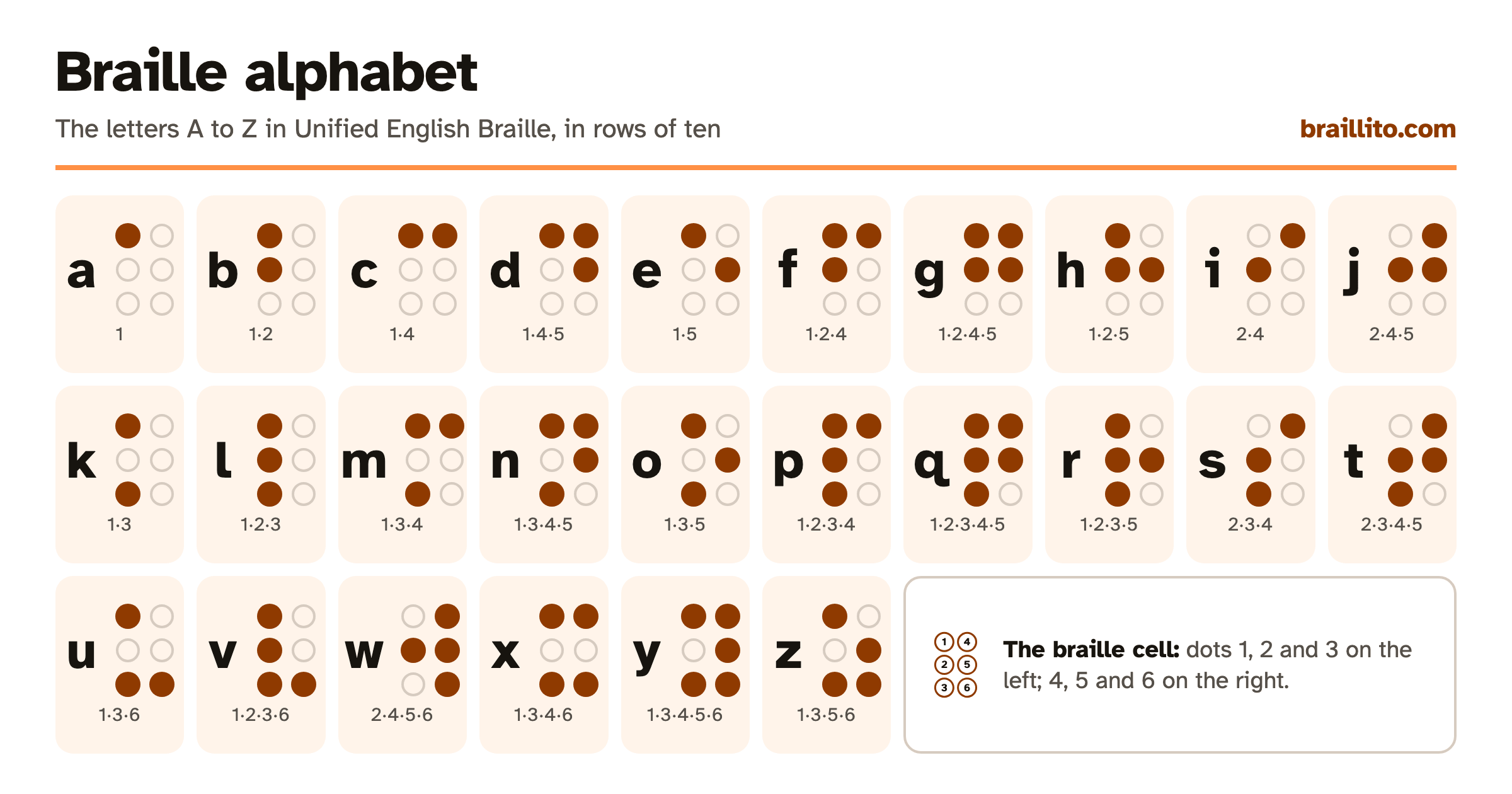
Braille writes each letter as a pattern of raised dots in a cell of six, arranged in two columns of three. The dots are numbered 1, 2 and 3 down the left column and 4, 5 and 6 down the right, and they make 64 possible combinations, the empty cell among them. English braille uses the same 26 letters as nearly every language written in the Latin alphabet, and adds a cell in front of a letter to mark a capital or a number.
Every cell on this page is Unicode braille, so you can copy it (all 64 cells are in braille symbols to copy and paste). To turn your own text into braille, use the braille translator; to read cells or dot numbers back, the braille to English translator.
The 26 letters
Sentences, numbers and Grade 2: braille translator
| Letter | Braille | Dots |
|---|---|---|
| A in braille | ⠁ | 1 |
| B in braille | ⠃ | 1-2 |
| C in braille | ⠉ | 1-4 |
| D in braille | ⠙ | 1-4-5 |
| E in braille | ⠑ | 1-5 |
| F in braille | ⠋ | 1-2-4 |
| G in braille | ⠛ | 1-2-4-5 |
| H in braille | ⠓ | 1-2-5 |
| I in braille | ⠊ | 2-4 |
| J in braille | ⠚ | 2-4-5 |
| K in braille | ⠅ | 1-3 |
| L in braille | ⠇ | 1-2-3 |
| M in braille | ⠍ | 1-3-4 |
| N in braille | ⠝ | 1-3-4-5 |
| O in braille | ⠕ | 1-3-5 |
| P in braille | ⠏ | 1-2-3-4 |
| Q in braille | ⠟ | 1-2-3-4-5 |
| R in braille | ⠗ | 1-2-3-5 |
| S in braille | ⠎ | 2-3-4 |
| T in braille | ⠞ | 2-3-4-5 |
| U in braille | ⠥ | 1-3-6 |
| V in braille | ⠧ | 1-2-3-6 |
| W in braille | ⠺ | 2-4-5-6 |
| X in braille | ⠭ | 1-3-4-6 |
| Y in braille | ⠽ | 1-3-4-5-6 |
| Z in braille | ⠵ | 1-3-5-6 |
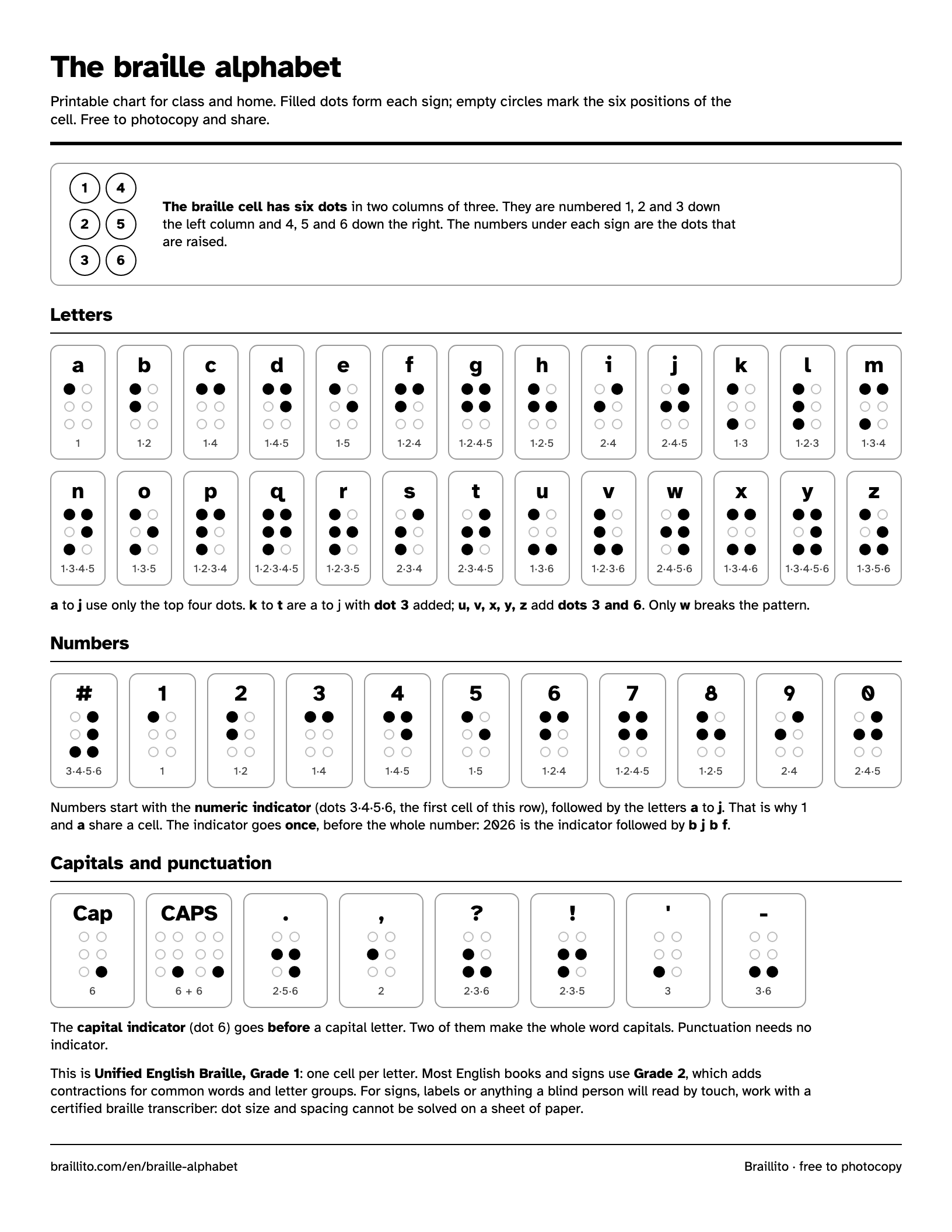
Printable braille alphabet and numbers chart
One US Letter page with the numbered cell, the 26 letters, the digits with the numeric indicator, the capital indicators and basic punctuation, each with its dot numbers. It is free to print and photocopy.
Download PDF (US Letter, one page) Download PNG
Alphabet flashcards and a Unified English Braille chart are on our braille printables page.
The pattern behind the alphabet
The alphabet is built in rows of ten. The first ten letters, a to j, use only the top four dots: 1, 2, 4 and 5. The next ten, k to t, are the same shapes with dot 3 added, so k is a plus dot 3 and l is b plus dot 3. u, v, x, y and z are a to e with dots 3 and 6 added. w is the exception: it does not follow the pattern.
| a–j | ⠁ a |
⠃ b |
⠉ c |
⠙ d |
⠑ e |
⠋ f |
⠛ g |
⠓ h |
⠊ i |
⠚ j |
|---|---|---|---|---|---|---|---|---|---|---|
| k–t: + dot 3 | ⠅ k |
⠇ l |
⠍ m |
⠝ n |
⠕ o |
⠏ p |
⠟ q |
⠗ r |
⠎ s |
⠞ t |
| u–z: + dots 3, 6 | ⠥ u |
⠧ v |
⠭ x |
⠽ y |
⠵ z |
⠺ w |
Learn the first ten well and the next fifteen come almost for free. A step-by-step plan is in how to learn braille, and more ways to remember the letters are in how to memorize the braille alphabet.
Louis Braille settled on this six-dot cell around 1824, at fifteen, and published the method in 1829. How he got there is in Louis Braille.
Capitals and numbers
Unified English Braille has no separate capital letters and no separate digits. A cell in front of the letter changes what it means.
For big numbers, decimals, prices and where a number ends, see the braille numbers chart.
| Indicator | Braille | Dots | What it does |
|---|---|---|---|
| Capital indicator | ⠠ | 6 | The next letter is a capital. |
| Capitalized word indicator | ⠠⠠ | 6 6 | The whole word is in capitals. |
| Numeric indicator | ⠼ | 3-4-5-6 | The letters a to j that follow are the digits 1 to 0. |
| 1–0 | ⠼⠁ 1 3-4-5-6 1 |
⠼⠃ 2 3-4-5-6 1-2 |
⠼⠉ 3 3-4-5-6 1-4 |
⠼⠙ 4 3-4-5-6 1-4-5 |
⠼⠑ 5 3-4-5-6 1-5 |
⠼⠋ 6 3-4-5-6 1-2-4 |
⠼⠛ 7 3-4-5-6 1-2-4-5 |
⠼⠓ 8 3-4-5-6 1-2-5 |
⠼⠊ 9 3-4-5-6 2-4 |
⠼⠚ 0 3-4-5-6 2-4-5 |
|---|
Punctuation
Most punctuation uses the lower part of the cell. Parentheses take two cells, and quotation marks have one cell to open and another to close.
| Mark | Name | Braille | Dots |
|---|---|---|---|
| . | Period (full stop) | ⠲ | 2-5-6 |
| , | Comma | ⠂ | 2 |
| ? | Question mark | ⠦ | 2-3-6 |
| ! | Exclamation mark | ⠖ | 2-3-5 |
| : | Colon | ⠒ | 2-5 |
| ; | Semicolon | ⠆ | 2-3 |
| ' | Apostrophe | ⠄ | 3 |
| - | Hyphen | ⠤ | 3-6 |
| “ | Opening quotation mark | ⠦ | 2-3-6 |
| ” | Closing quotation mark | ⠴ | 3-5-6 |
| ( | Opening parenthesis | ⠐⠣ | 5 1-2-6 |
| ) | Closing parenthesis | ⠐⠜ | 5 3-4-5 |
Dashes, slashes, brackets and the other marks are in the braille punctuation chart.
After the alphabet: contracted braille
This chart is Grade 1: every word is spelled letter by letter, with no contractions. Most English books and signs use Grade 2, which adds contractions for common words and letter groups, such as ⠮ for “the” and ⠸⠺ for “world”. Type any text into the braille translator to see it both ways, or see all 180 in braille contractions.
Braille cell size on ADA signs
A cell is small enough to fit under a fingertip; how its six dots work is in what is braille. For signs in the United States, the 2010 ADA Standards (section 703.3) set the sizes:
| Dot base diameter | 0.059 to 0.063 inch (1.5 to 1.6 mm) |
|---|---|
| Between dots in a cell, center to center | 0.090 to 0.100 inch (2.3 to 2.5 mm) |
| Between matching dots of side-by-side cells, center to center | 0.241 to 0.300 inch (6.1 to 7.6 mm) |
Which signs need braille and where it goes: braille signs and the ADA.
For teachers
For a class, photocopy the printable chart above. More free material is in free braille resources, help for a blind student in teaching braille to a blind child, and what a school can use in Braillito for schools.
Frequently asked questions
How many letters are in the braille alphabet?
Twenty-six, the same as the print alphabet. Braille has no separate capital letters: a capital is the same cell with the capital indicator, dot 6 (⠠), in front of it.
Is the braille alphabet the same in every language?
The 26 basic letters are shared by most languages written with the Latin alphabet. Accented letters, punctuation and contractions differ from one language to another, and languages such as Japanese, Korean or Arabic assign the cells to their own writing systems. This page shows Unified English Braille (UEB), the code used in the United States, the United Kingdom, Canada, Australia, New Zealand, Ireland, South Africa and Nigeria. More in braille in other languages.
How are numbers written in braille?
With the numeric indicator (⠼, dots 3-4-5-6) once in front of the letters a to j, which then stand for 1 to 0, so 2026 is ⠼⠃⠚⠃⠋. Big numbers, decimals and prices are in braille numbers.
Why is w different from the other letters?
u, v, x, y and z are a to e with dots 3 and 6 added, but w (⠺, dots 2-4-5-6) does not follow that pattern. It has its own cell, so it is worth learning on its own.
What is Grade 2 braille?
Grade 2, or contracted braille, adds shortcuts for common words and letter groups, such as ⠮ for “the”. Most English books and signs use it. You can see any text in Grade 1 or Grade 2 with our braille translator.
From the chart to reading
A chart is for looking up. Reading braille by touch takes practice
Braillito teaches braille from scratch, with 59 lessons in 8 worlds, in 38 languages, English included.
Works with VoiceOver and TalkBack