
Braille alphabet
Unified English Braille (UEB) chart
Every sign of UEB on one page: the letters, numbers and capitals, punctuation and symbols, the indicators and all 180 contractions, each drawn cell by cell with its dot numbers.
In short. Unified English Braille (UEB) is the braille code for English set by the International Council on English Braille (ICEB). The United States adopted it in 2012 and set January 4, 2016 as the date for general use. The letters did not change; some punctuation, symbols and indicators did, and nine contractions were dropped.
Updated
What is Unified English Braille?
UEB is the braille code for English set by the International Council on English Braille (ICEB), whose members include the United States, the United Kingdom, Canada and Australia. It replaced older codes such as English Braille American Edition (EBAE) with one set of rules for text.
In the United States, the Braille Authority of North America (BANA) adopted UEB on November 2, 2012 and set January 4, 2016 as the date for general use. For math and science, BANA kept the Nemeth Code.
The letters, the digits and most contractions did not change. What changed is a set of punctuation marks and symbols, the italic indicators and nine contractions, all in UEB vs EBAE.
Are the letters different in UEB?
No. The 26 letters are the same cells as in every other English braille code: a to j use only dots 1, 2, 4 and 5, k to t add dot 3, and u, v, x, y and z add dots 3 and 6.
W is the exception: it is dots 2, 4, 5 and 6, outside the series. How the series work is in the braille cell.
The 26 letters
- ⠁a1
- ⠃b1-2
- ⠉c1-4
- ⠙d1-4-5
- ⠑e1-5
- ⠋f1-2-4
- ⠛g1-2-4-5
- ⠓h1-2-5
- ⠊i2-4
- ⠚j2-4-5
- ⠅k1-3
- ⠇l1-2-3
- ⠍m1-3-4
- ⠝n1-3-4-5
- ⠕o1-3-5
- ⠏p1-2-3-4
- ⠟q1-2-3-4-5
- ⠗r1-2-3-5
- ⠎s2-3-4
- ⠞t2-3-4-5
- ⠥u1-3-6
- ⠧v1-2-3-6
- ⠺w2-4-5-6
- ⠭x1-3-4-6
- ⠽y1-3-4-5-6
- ⠵z1-3-5-6
How are numbers written in UEB?
Numbers start with the numeric indicator, dots 3, 4, 5 and 6. The digits 1 to 9 and 0 are the letters a to j, and they stay digits until a space or any symbol other than a digit, period, comma, numeric space or fraction line.
So 3,500 and 8.93 need one indicator, while a hyphen or a colon ends the number and 9-10 needs two. A lowercase letter a to j right after digits would read as a digit, so it takes the grade 1 indicator, dots 5 and 6: compare 22b with 22p and 22B.
More in our guide to braille numbers.
The numeric indicator and the digits
- ⠼Numeric indicator3-4-5-6
- ⠁1same cell as a1
- ⠃2same cell as b1-2
- ⠉3same cell as c1-4
- ⠙4same cell as d1-4-5
- ⠑5same cell as e1-5
- ⠋6same cell as f1-2-4
- ⠛7same cell as g1-2-4-5
- ⠓8same cell as h1-2-5
- ⠊9same cell as i2-4
- ⠚0same cell as j2-4-5
| Braille | Dots | Why | |
|---|---|---|---|
| 62 | ⠼⠋⠃ | 3-4-5-6 1-2-4 1-2 | The numeric indicator, then the cells of f and b. |
| 3,500 | ⠼⠉⠂⠑⠚⠚ | 3-4-5-6 1-4 2 1-5 2-4-5 2-4-5 | The comma keeps the number going: one indicator. |
| 8.93 | ⠼⠓⠲⠊⠉ | 3-4-5-6 1-2-5 2-5-6 2-4 1-4 | So does the period. |
| 7:30 | ⠼⠛⠒⠼⠉⠚ | 3-4-5-6 1-2-4-5 2-5 3-4-5-6 1-4 2-4-5 | The colon ends it, so 30 takes the indicator again. |
| 9-10 | ⠼⠊⠤⠼⠁⠚ | 3-4-5-6 2-4 3-6 3-4-5-6 1 2-4-5 | So does the hyphen: two numbers, two indicators. |
| 22b | ⠼⠃⠃⠰⠃ | 3-4-5-6 1-2 1-2 5-6 1-2 | b after digits would read as 2: the grade 1 indicator, dots 5 and 6, comes first. |
| 22p | ⠼⠃⠃⠏ | 3-4-5-6 1-2 1-2 1-2-3-4 | p is not one of the digit letters, so it needs no indicator. |
| 22B | ⠼⠃⠃⠠⠃ | 3-4-5-6 1-2 1-2 6 1-2 | The capital indicator already shows it is a letter. |
How do capitals work in UEB?
Dot 6 before a letter makes it a capital. Two dot-6 cells make the whole word capitals, and three start a capitals passage of three or more words, which the capitals terminator, dots 6 and 3, closes.
The capitals word indicator lasts until a space, a symbol that is not a letter, or the capitals terminator. That is why UEBs needs the terminator before its lowercase s.
| Indicator | Braille | Dots |
|---|---|---|
| Capital letter | ⠠ | 6 |
| Capitals word | ⠠⠠ | 6 6 |
| Capitals passage | ⠠⠠⠠ | 6 6 6 |
| Capitals terminator | ⠠⠄ | 6 3 |
| Braille | Dots | Why | |
|---|---|---|---|
| Ann | ⠠⠁⠝⠝ | 6 1 1-3-4-5 1-3-4-5 | Dot 6 before the first letter only. |
| UEB | ⠠⠠⠥⠑⠃ | 6 6 1-3-6 1-5 1-2 | Two dot-6 cells: the whole word is capitals. |
| UEBs | ⠠⠠⠥⠑⠃⠠⠄⠎ | 6 6 1-3-6 1-5 1-2 6 3 2-3-4 | The capitals terminator, dots 6 and 3, before the lowercase s. |
| BIG FAT CAT | ⠠⠠⠠⠃⠊⠛⠀⠋⠁⠞⠀⠉⠁⠞⠠⠄ | 6 6 6 1-2 2-4 1-2-4-5 (space) 1-2-4 1 2-3-4-5 (space) 1-4 1 2-3-4-5 6 3 | Three words: the capitals passage indicator, closed by the terminator. |
What does punctuation look like in UEB?
Most marks are a single cell: the comma is dot 2, the period dots 2, 5 and 6, and the question mark dots 2, 3 and 6. Brackets, the dash and the single quotation marks take two cells.
All brackets share their second cell: dots 1, 2 and 6 to open and dots 3, 4 and 5 to close. The first cell says which: dot 5 for round brackets, dots 4 and 6 for square ones and dots 4, 5 and 6 for curly ones.
The question mark and the opening double quotation mark are the same cell, which is also “his” in grade 2: where it stands tells them apart. More in braille punctuation.
Punctuation
- ⠂,comma2
- ⠆;semicolon2-3
- ⠒:colon2-5
- ⠲.period2-5-6
- ⠖!exclamation mark2-3-5
- ⠦?question mark2-3-6
- ⠄'apostrophe3
- ⠤-hyphen3-6
- ⠠⠤–dash6 3-6
- ⠲⠲⠲…ellipsis2-5-6 2-5-6 2-5-6
- ⠦“opening double quotation mark2-3-6
- ⠴”closing double quotation mark3-5-6
- ⠠⠦‘opening single quotation mark6 2-3-6
- ⠠⠴’closing single quotation mark6 3-5-6
- ⠐⠣(opening parenthesis5 1-2-6
- ⠐⠜)closing parenthesis5 3-4-5
- ⠨⠣[opening square bracket4-6 1-2-6
- ⠨⠜]closing square bracket4-6 3-4-5
- ⠸⠣{opening curly bracket4-5-6 1-2-6
- ⠸⠜}closing curly bracket4-5-6 3-4-5
How are symbols written in UEB?
Most symbols take two cells: a prefix made of dots from the right column (4, 5 and 6) and a root cell. The math signs plus, minus, times, divided by and equals all start with dot 5.
Some roots are letters: the dollar sign is dot 4 and s, the at sign dot 4 and a, and the copyright sign dots 4 and 5 and c. The ampersand is dot 4 and the cell for “and”.
More in our guide to braille symbols.
Symbols
- ⠈⠎$dollar4 2-3-4
- ⠨⠴%percent4-6 3-5-6
- ⠸⠹#number sign4-5-6 1-4-5-6
- ⠈⠯&ersand4 1-2-3-4-6
- ⠈⠁@at sign4 1
- ⠐⠔*asterisk5 3-5
- ⠸⠌/slash4-5-6 3-4
- ⠨⠤_underscore4-6 3-6
- ⠘⠚°degree4-5 2-4-5
- ⠘⠉©copyright4-5 1-4
- ⠐⠖+plus5 2-3-5
- ⠐⠤−minus5 3-6
- ⠐⠦×times5 2-3-6
- ⠐⠌÷divided by5 3-4
- ⠐⠶=equals5 2-3-5-6
What are grade 1 indicators?
They tell the reader that the next cells have their grade 1 meaning: a letter or a punctuation mark, not a contraction or a digit. Dots 5 and 6 cover one symbol; doubled, they cover a word, and tripled, a passage that ends with the grade 1 terminator.
In grade 2, the cell of b standing alone means “but”, so the letter b on its own takes the indicator. The letters a, i and o need none: alone, they are not contractions.
The rulebook’s own example is in the table: in “the vowels are: a, e, i, o and u”, only e and u take the indicator.
| Indicator | Braille | Dots | Covers |
|---|---|---|---|
| Grade 1 symbol indicator | ⠰ | 5-6 | The next symbol |
| Grade 1 word indicator | ⠰⠰ | 5-6 5-6 | The next word |
| Grade 1 passage indicator | ⠰⠰⠰ | 5-6 5-6 5-6 | Three or more words |
| Grade 1 terminator | ⠰⠄ | 5-6 3 | Ends a word or passage indicator |
| Braille | Dots | Why | |
|---|---|---|---|
| b | ⠰⠃ | 5-6 1-2 | Alone, the cell of b means “but”: the indicator makes it the letter. |
| a, e, i | ⠁⠂⠀⠰⠑⠂⠀⠊ | 1 2 (space) 5-6 1-5 2 (space) 2-4 | a and i need nothing; e alone takes the indicator. |
| the vowels are: a, e, i, o and u | ⠮⠀⠧⠪⠑⠇⠎⠀⠜⠑⠒⠀⠁⠂⠀⠰⠑⠂⠀⠊⠂⠀⠕⠀⠯⠀⠰⠥ | 2-3-4-6 (space) 1-2-3-6 2-4-6 1-5 1-2-3 2-3-4 (space) 3-4-5 1-5 2-5 (space) 1 2 (space) 5-6 1-5 2 (space) 2-4 2 (space) 1-3-5 (space) 1-2-3-4-6 (space) 5-6 1-3-6 | The rulebook’s own example: only e and u take the indicator. |
How are italics and bold shown?
With typeform indicators. Each has a prefix, dots 4 and 6 for italic, dots 4 and 5 for bold, dots 4, 5 and 6 for underline and dot 4 for script, and a second cell for how far it reaches: one symbol, one word or a passage.
The second cell is the same for all four: dots 2 and 3 for one symbol, dot 2 for one word, dots 2, 3, 5 and 6 for a passage of three or more words, and dot 3 for the terminator that ends a passage, or a word part way.
EBAE marked an italic word with dots 4 and 6 alone and doubled them for a passage; UEB adds the second cell.
| Typeform | Symbol | Word | Passage | Terminator |
|---|---|---|---|---|
| Italic | ⠨⠆4-6 2-3 | ⠨⠂4-6 2 | ⠨⠶4-6 2-3-5-6 | ⠨⠄4-6 3 |
| Bold | ⠘⠆4-5 2-3 | ⠘⠂4-5 2 | ⠘⠶4-5 2-3-5-6 | ⠘⠄4-5 3 |
| Underline | ⠸⠆4-5-6 2-3 | ⠸⠂4-5-6 2 | ⠸⠶4-5-6 2-3-5-6 | ⠸⠄4-5-6 3 |
| Script | ⠈⠆4 2-3 | ⠈⠂4 2 | ⠈⠶4 2-3-5-6 | ⠈⠄4 3 |
How many contractions does UEB have?
180. They are the grade 2 signs: one or more cells that stand for a whole word or a group of letters. EBAE had 189; UEB dropped nine, listed in UEB vs EBAE.
Each group has its own rule for where it may be used, summed up in the table. The two-cell signs are in initial-letter and final-letter contractions, and the abbreviated words in shortforms.
Some lower signs share a cell with punctuation: be and bb with the semicolon, con and cc with the colon, dis with the period, ff with the exclamation mark and his with the question mark. Where the cell stands tells them apart.
How to read them in running text is in our guide to braille contractions.
| Group | Signs | Where it is used |
|---|---|---|
| Alphabetic wordsigns | 23 | As whole words |
| Strong contractions | 5 | As words and wherever the letters occur |
| Strong wordsigns | 6 | As whole words |
| Strong groupsigns | 12 | Wherever the letters occur, with a few exceptions |
| Lower wordsigns | 6 | As whole words; be, were, his and was not touching lower punctuation |
| Lower groupsigns | 10 | be, con and dis at the start of a word; ea, bb, cc, ff and gg between letters; en and in anywhere |
| Initial-letter contractions | 33 | As words and inside words, with exceptions |
| Final-letter groupsigns | 12 | After a letter, never at the start of a word |
| Shortforms | 75 | As words and in some longer words |
| Total | 180 | be and in count once |
Alphabetic wordsigns (23)
A letter standing alone is a whole word.
- ⠃butb1-2
- ⠉canc1-4
- ⠙dod1-4-5
- ⠑everye1-5
- ⠋fromf1-2-4
- ⠛gog1-2-4-5
- ⠓haveh1-2-5
- ⠚justj2-4-5
- ⠅knowledgek1-3
- ⠇likel1-2-3
- ⠍morem1-3-4
- ⠝notn1-3-4-5
- ⠏peoplep1-2-3-4
- ⠟quiteq1-2-3-4-5
- ⠗ratherr1-2-3-5
- ⠎sos2-3-4
- ⠞thatt2-3-4-5
- ⠥usu1-3-6
- ⠧veryv1-2-3-6
- ⠺willw2-4-5-6
- ⠭itx1-3-4-6
- ⠽youy1-3-4-5-6
- ⠵asz1-3-5-6
Strong contractions (5)
- ⠯and1-2-3-4-6
- ⠿for1-2-3-4-5-6
- ⠷of1-2-3-5-6
- ⠮the2-3-4-6
- ⠾with2-3-4-5-6
Strong wordsigns (6)
- ⠡child1-6
- ⠩shall1-4-6
- ⠹this1-4-5-6
- ⠱which1-5-6
- ⠳out1-2-5-6
- ⠌still3-4
Strong groupsigns (12)
- ⠡chas in rich1-6
- ⠣ghas in sigh1-2-6
- ⠩shas in fish1-4-6
- ⠹thas in math1-4-5-6
- ⠱whas in whip1-5-6
- ⠫edas in fed1-2-4-6
- ⠻eras in her1-2-4-5-6
- ⠳ouas in loud1-2-5-6
- ⠪owas in cow2-4-6
- ⠌stas in mist3-4
- ⠜aras in car3-4-5
- ⠬ingas in ring3-4-6
Lower wordsigns (6)
- ⠆be2-3
- ⠢enough2-6
- ⠶were2-3-5-6
- ⠦his2-3-6
- ⠔in3-5
- ⠴was3-5-6
Lower groupsigns (10)
- ⠆beas in betray2-3
- ⠒conas in convey2-5
- ⠲disas in dismal2-5-6
- ⠂eaas in meat2
- ⠆bbas in rabbit2-3
- ⠒ccas in occur2-5
- ⠖ffas in taffy2-3-5
- ⠶ggas in foggy2-3-5-6
- ⠢enas in tent2-6
- ⠔inas in pint3-5
What are initial-letter and final-letter contractions?
Initial-letter contractions are two cells: dot 5, dots 4 and 5, or dots 4, 5 and 6, then the first letter of the word or its first groupsign. Dot 5 and d is “day”; dot 5 and th is “through”.
Final-letter groupsigns are dots 4 and 6, or dots 5 and 6, then the last letter of the group: dots 5 and 6 and n is “tion”, as in nation. They are only used after a letter, never at the start of a word.
Initial-letter, Dots 4-5 (5)
- ⠘⠥upon4-5 1-3-6
- ⠘⠮these4-5 2-3-4-6
- ⠘⠹those4-5 1-4-5-6
- ⠘⠱whose4-5 1-5-6
- ⠘⠺word4-5 2-4-5-6
Initial-letter, Dots 4-5-6 (6)
- ⠸⠉cannot4-5-6 1-4
- ⠸⠓had4-5-6 1-2-5
- ⠸⠍many4-5-6 1-3-4
- ⠸⠎spirit4-5-6 2-3-4
- ⠸⠮their4-5-6 2-3-4-6
- ⠸⠺world4-5-6 2-4-5-6
Initial-letter, Dot 5 (22)
- ⠐⠙day5 1-4-5
- ⠐⠑ever5 1-5
- ⠐⠋father5 1-2-4
- ⠐⠓here5 1-2-5
- ⠐⠅know5 1-3
- ⠐⠇lord5 1-2-3
- ⠐⠍mother5 1-3-4
- ⠐⠝name5 1-3-4-5
- ⠐⠕one5 1-3-5
- ⠐⠏part5 1-2-3-4
- ⠐⠟question5 1-2-3-4-5
- ⠐⠗right5 1-2-3-5
- ⠐⠎some5 2-3-4
- ⠐⠞time5 2-3-4-5
- ⠐⠥under5 1-3-6
- ⠐⠽young5 1-3-4-5-6
- ⠐⠮there5 2-3-4-6
- ⠐⠡character5 1-6
- ⠐⠹through5 1-4-5-6
- ⠐⠱where5 1-5-6
- ⠐⠳ought5 1-2-5-6
- ⠐⠺work5 2-4-5-6
Final-letter, dots 4-6 (5)
- ⠨⠙oundas in round4-6 1-4-5
- ⠨⠑anceas in dance4-6 1-5
- ⠨⠝sionas in mission4-6 1-3-4-5
- ⠨⠎lessas in unless4-6 2-3-4
- ⠨⠞ountas in count4-6 2-3-4-5
Final-letter, dots 5-6 (7)
- ⠰⠑enceas in fence5-6 1-5
- ⠰⠛ongas in song5-6 1-2-4-5
- ⠰⠇fulas in useful5-6 1-2-3
- ⠰⠝tionas in nation5-6 1-3-4-5
- ⠰⠎nessas in illness5-6 2-3-4
- ⠰⠞mentas in moment5-6 2-3-4-5
- ⠰⠽ityas in city5-6 1-3-4-5-6
What are shortforms?
Abbreviated spellings of 75 common words, such as ab for “about”, bl for “blind” and qk for “quick”. They are used as words and, within limits, inside longer words.
When a shortform may go inside a longer word is set out in section 10.9 of the UEB rulebook, listed in the sources below.
The 75 shortforms
- ⠁⠃about1 1-2
- ⠁⠃⠧above1 1-2 1-2-3-6
- ⠁⠉according1 1-4
- ⠁⠉⠗across1 1-4 1-2-3-5
- ⠁⠋after1 1-2-4
- ⠁⠋⠝afternoon1 1-2-4 1-3-4-5
- ⠁⠋⠺afterward1 1-2-4 2-4-5-6
- ⠁⠛again1 1-2-4-5
- ⠁⠛⠌against1 1-2-4-5 3-4
- ⠁⠇also1 1-2-3
- ⠁⠇⠍almost1 1-2-3 1-3-4
- ⠁⠇⠗already1 1-2-3 1-2-3-5
- ⠁⠇⠞altogether1 1-2-3 2-3-4-5
- ⠁⠇⠹although1 1-2-3 1-4-5-6
- ⠁⠇⠺always1 1-2-3 2-4-5-6
- ⠃⠇blind1-2 1-2-3
- ⠃⠗⠇braille1-2 1-2-3-5 1-2-3
- ⠉⠙could1-4 1-4-5
- ⠙⠉⠇declare1-4-5 1-4 1-2-3
- ⠙⠉⠇⠛declaring1-4-5 1-4 1-2-3 1-2-4-5
- ⠙⠉⠧deceive1-4-5 1-4 1-2-3-6
- ⠙⠉⠧⠛deceiving1-4-5 1-4 1-2-3-6 1-2-4-5
- ⠑⠊either1-5 2-4
- ⠋⠗friend1-2-4 1-2-3-5
- ⠋⠌first1-2-4 3-4
- ⠛⠙good1-2-4-5 1-4-5
- ⠛⠗⠞great1-2-4-5 1-2-3-5 2-3-4-5
- ⠓⠍him1-2-5 1-3-4
- ⠓⠍⠋himself1-2-5 1-3-4 1-2-4
- ⠓⠻⠋herself1-2-5 1-2-4-5-6 1-2-4
- ⠊⠍⠍immediate2-4 1-3-4 1-3-4
- ⠇⠇little1-2-3 1-2-3
- ⠇⠗letter1-2-3 1-2-3-5
- ⠍⠽⠋myself1-3-4 1-3-4-5-6 1-2-4
- ⠍⠡much1-3-4 1-6
- ⠍⠌must1-3-4 3-4
- ⠝⠑⠉necessary1-3-4-5 1-5 1-4
- ⠝⠑⠊neither1-3-4-5 1-5 2-4
- ⠏⠙paid1-2-3-4 1-4-5
- ⠏⠻⠉⠧perceive1-2-3-4 1-2-4-5-6 1-4 1-2-3-6
- ⠏⠻⠉⠧⠛perceiving1-2-3-4 1-2-4-5-6 1-4 1-2-3-6 1-2-4-5
- ⠏⠻⠓perhaps1-2-3-4 1-2-4-5-6 1-2-5
- ⠟⠅quick1-2-3-4-5 1-3
- ⠗⠉⠧receive1-2-3-5 1-4 1-2-3-6
- ⠗⠉⠧⠛receiving1-2-3-5 1-4 1-2-3-6 1-2-4-5
- ⠗⠚⠉rejoice1-2-3-5 2-4-5 1-4
- ⠗⠚⠉⠛rejoicing1-2-3-5 2-4-5 1-4 1-2-4-5
- ⠎⠙said2-3-4 1-4-5
- ⠎⠡such2-3-4 1-6
- ⠞⠙today2-3-4-5 1-4-5
- ⠞⠛⠗together2-3-4-5 1-2-4-5 1-2-3-5
- ⠞⠍tomorrow2-3-4-5 1-3-4
- ⠞⠝tonight2-3-4-5 1-3-4-5
- ⠭⠋itself1-3-4-6 1-2-4
- ⠭⠎its1-3-4-6 2-3-4
- ⠽⠗your1-3-4-5-6 1-2-3-5
- ⠽⠗⠋yourself1-3-4-5-6 1-2-3-5 1-2-4
- ⠽⠗⠧⠎yourselves1-3-4-5-6 1-2-3-5 1-2-3-6 2-3-4
- ⠮⠍⠧⠎themselves2-3-4-6 1-3-4 1-2-3-6 2-3-4
- ⠡⠝children1-6 1-3-4-5
- ⠩⠙should1-4-6 1-4-5
- ⠹⠽⠋thyself1-4-5-6 1-3-4-5-6 1-2-4
- ⠳⠗⠧⠎ourselves1-2-5-6 1-2-3-5 1-2-3-6 2-3-4
- ⠺⠙would2-4-5-6 1-4-5
- ⠆⠉because2-3 1-4
- ⠆⠋before2-3 1-2-4
- ⠆⠓behind2-3 1-2-5
- ⠆⠇below2-3 1-2-3
- ⠆⠝beneath2-3 1-3-4-5
- ⠆⠎beside2-3 2-3-4
- ⠆⠞between2-3 2-3-4-5
- ⠆⠽beyond2-3 1-3-4-5-6
- ⠒⠉⠧conceive2-5 1-4 1-2-3-6
- ⠒⠉⠧⠛conceiving2-5 1-4 1-2-3-6 1-2-4-5
- ⠐⠕⠋oneself5 1-3-5 1-2-4
What changed from EBAE to UEB?
Nine contractions were dropped, several punctuation marks and symbols got new signs, italics gained a second cell, and a, and, for, of, the and with are no longer run together without a space.
In the table, the EBAE column comes from the EBAE table of liblouis and the UEB column from its UEB table; every change is in section 1.3 of the UEB rulebook.
More on the switch in our guide to Unified English Braille.
The nine dropped contractions
As EBAE wrote them.
- ⠕⠄⠉o’clock1-3-5 3 1-4
- ⠲dd2-5-6
- ⠖to2-3-5
- ⠔⠖into3-5 2-3-5
- ⠴by3-5-6
- ⠼ble3-4-5-6
- ⠤com3-6
- ⠠⠝ation6 1-3-4-5
- ⠠⠽ally6 1-3-4-5-6
| EBAE | UEB | What changed | |
|---|---|---|---|
| (no) | ⠶⠝⠕⠶2-3-5-6 1-3-4-5 1-3-5 2-3-5-6 | ⠐⠣⠝⠕⠐⠜5 1-2-6 1-3-4-5 1-3-5 5 3-4-5 | Parentheses |
| [no] | ⠠⠶⠝⠕⠶⠄6 2-3-5-6 1-3-4-5 1-3-5 2-3-5-6 3 | ⠨⠣⠝⠕⠨⠜4-6 1-2-6 1-3-4-5 1-3-5 4-6 3-4-5 | Square brackets |
| yes–no | ⠽⠑⠎⠤⠤⠝⠕1-3-4-5-6 1-5 2-3-4 3-6 3-6 1-3-4-5 1-3-5 | ⠽⠑⠎⠠⠤⠝⠕1-3-4-5-6 1-5 2-3-4 6 3-6 1-3-4-5 1-3-5 | Dash |
| yes… | ⠽⠑⠎⠄⠄⠄1-3-4-5-6 1-5 2-3-4 3 3 3 | ⠽⠑⠎⠲⠲⠲1-3-4-5-6 1-5 2-3-4 2-5-6 2-5-6 2-5-6 | Ellipsis |
| $5 | ⠲⠼⠑2-5-6 3-4-5-6 1-5 | ⠈⠎⠼⠑4 2-3-4 3-4-5-6 1-5 | Dollar sign |
| yes* | ⠽⠑⠎⠔⠔1-3-4-5-6 1-5 2-3-4 3-5 3-5 | ⠽⠑⠎⠐⠔1-3-4-5-6 1-5 2-3-4 5 3-5 | Asterisk |
| and the | ⠯⠮1-2-3-4-6 2-3-4-6 | ⠯⠀⠮1-2-3-4-6 (space) 2-3-4-6 | “and the” is written with a space |
| to the | ⠖⠮2-3-5 2-3-4-6 | ⠞⠕⠀⠮2-3-4-5 1-3-5 (space) 2-3-4-6 | “to” contraction dropped |
| by the | ⠴⠮3-5-6 2-3-4-6 | ⠃⠽⠀⠮1-2 1-3-4-5-6 (space) 2-3-4-6 | “by” contraction dropped |
| into the | ⠔⠖⠮3-5 2-3-5 2-3-4-6 | ⠔⠞⠕⠀⠮3-5 2-3-4-5 1-3-5 (space) 2-3-4-6 | “into” contraction dropped |
| middle | ⠍⠊⠲⠇⠑1-3-4 2-4 2-5-6 1-2-3 1-5 | ⠍⠊⠙⠙⠇⠑1-3-4 2-4 1-4-5 1-4-5 1-2-3 1-5 | “dd” contraction dropped |
| table | ⠞⠁⠼2-3-4-5 1 3-4-5-6 | ⠞⠁⠃⠇⠑2-3-4-5 1 1-2 1-2-3 1-5 | “ble” contraction dropped |
| combine | ⠤⠃⠔⠑3-6 1-2 3-5 1-5 | ⠉⠕⠍⠃⠔⠑1-4 1-3-5 1-3-4 1-2 3-5 1-5 | “com” contraction dropped |
| nation | ⠝⠠⠝1-3-4-5 6 1-3-4-5 | ⠝⠁⠰⠝1-3-4-5 1 5-6 1-3-4-5 | “ation” contraction dropped |
| really | ⠗⠑⠠⠽1-2-3-5 1-5 6 1-3-4-5-6 | ⠗⠂⠇⠇⠽1-2-3-5 2 1-2-3 1-2-3 1-3-4-5-6 | “ally” contraction dropped |
| o'clock | ⠕⠄⠉1-3-5 3 1-4 | ⠕⠄⠉⠇⠕⠉⠅1-3-5 3 1-4 1-2-3 1-3-5 1-4 1-3 | “o’clock” contraction dropped |
Is there a printable UEB chart?
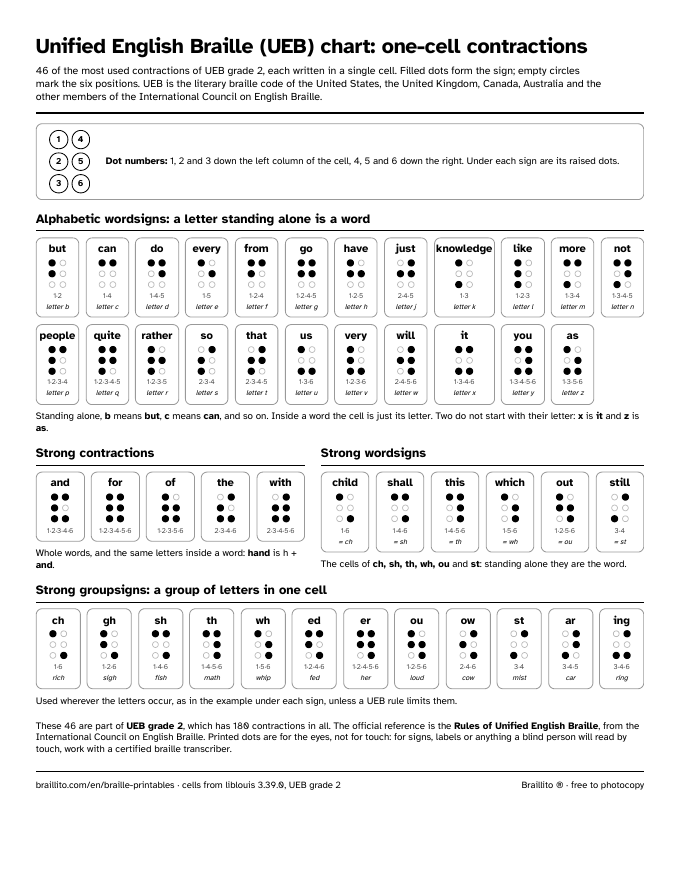
Yes: a one-page PDF, US Letter, with the 46 one-cell contractions you meet most: 23 alphabetic wordsigns, 5 strong contractions, 6 strong wordsigns and 12 strong groupsigns. It is free, with no sign-up.
Download the UEB chart (PDF) or find it with the other sheets in braille printables.
Frequently asked questions
Is UEB the same as grade 2 braille?
No. UEB is the code; grade 1 and grade 2 are two ways of writing it. Grade 1 spells words letter by letter, and grade 2 adds the contractions.
When did the United States switch to UEB?
BANA adopted UEB on November 2, 2012 and set January 4, 2016 as the date for general use. Before that, the US used English Braille American Edition (EBAE).
Why do the question mark and the opening quotation mark look the same?
They are the same cell, dots 2, 3 and 6, which is also the grade 2 wordsign for “his”. Where it stands tells them apart: before a word it opens a quotation, after one it is a question mark. A question mark standing alone takes the grade 1 indicator, dots 5 and 6, in front.
How many contractions are there in UEB?
180: 23 alphabetic wordsigns, 5 strong contractions, 6 strong wordsigns, 12 strong groupsigns, 6 lower wordsigns, 10 lower groupsigns, 33 initial-letter contractions, 12 final-letter groupsigns and 75 shortforms. “be” and “in” are both a wordsign and a groupsign with the same cell, so they count once. EBAE had 189.
Does UEB cover math?
UEB has its own math signs, such as the ones in the symbols chart above. In the United States, though, BANA kept the Nemeth Code for math and science when it adopted UEB. More in the Nemeth Code.
Sources
The signs and the rules on this page come from these documents.
- The Rules of Unified English Braille, third edition. International Council on English Braille (ICEB), 2024. Sections 1.3 (signs no longer used), 5 (grade 1 indicators), 6 (numbers), 8 (capitals), 9 (typeforms) and 10 (contractions).
- Unified English Braille (UEB). ICEB. What UEB is and the countries that use it.
- BANA Adopts Unified English Braille (UEB) for United States. Braille Authority of North America (BANA), November 2, 2012.
- November 2013: BANA Affirms Date for Implementation of UEB. BANA. January 4, 2016, the date for general use in the United States.
- Motion to Adopt UEB. BANA. UEB replaces EBAE; the Nemeth Code, music braille and IPA braille stay.
- liblouis 3.39.0. Open-source braille translator. Its UEB tables (grades 1 and 2) checked every cell on this page, and its EBAE table (en-us-g2) gave the EBAE column.
Learn braille
A guide is for reading. Braille is learned with your fingers.
59 lessons in 8 worlds to go from recognizing the letters to reading them without thinking.
The app is a subscription. If it is your first subscription, the monthly and 3-month plans can start with a 3-day free trial. The tools on this website are free.
38 languages · Works with VoiceOver and TalkBack · First place nationally in accessibility